
The first time I heard someone count three-one-two-three on every rep, I thought they were doing something I wasn’t. For years in my gym, the unspoken rule was simple: control that weight for 3 to 5 seconds or you’re leaving gains on the table.
It turns out we’ve been worrying about this more than the data supports.
The Why
The idea behind slow eccentrics is elegant. Lowering a weight slowly puts more tension on the muscle, so it should grow faster. Previous narrative reviews pointed to a combination of slow eccentric and fast concentric as ideal for maximizing gains — but even those reviews flagged limited evidence.
What the New Meta-Analysis Shows
A recent meta-analysis examined 14 studies that independently manipulated both the eccentric and concentric tempo. The included studies had participants training at least 2 times per week for 4 or more weeks, using direct muscle measurements like ultrasound.
Coach’s Math
- Total: 14 studies spanning roughly 8.5 weeks with approximately 280 participants
- Fast reps: concentric phase of about 0.25 to 1 second, eccentric phase of about 0.25 to 2 seconds
- Slow reps: concentric phase of about 2 to 4.5 seconds, eccentric phase of about 1.66 to 4.5 seconds
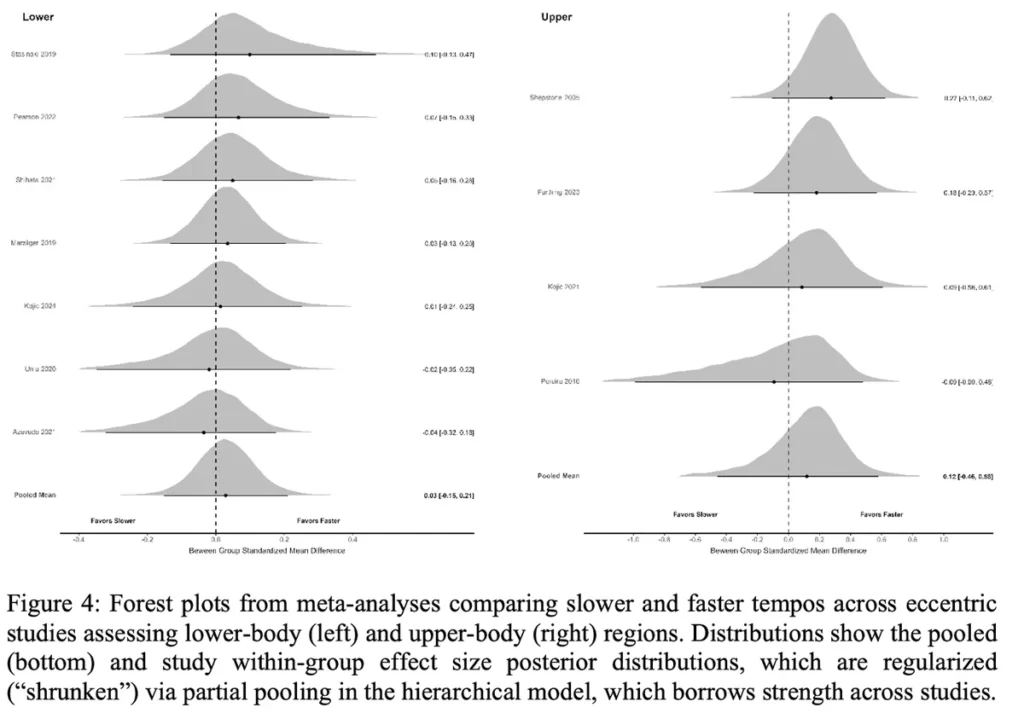
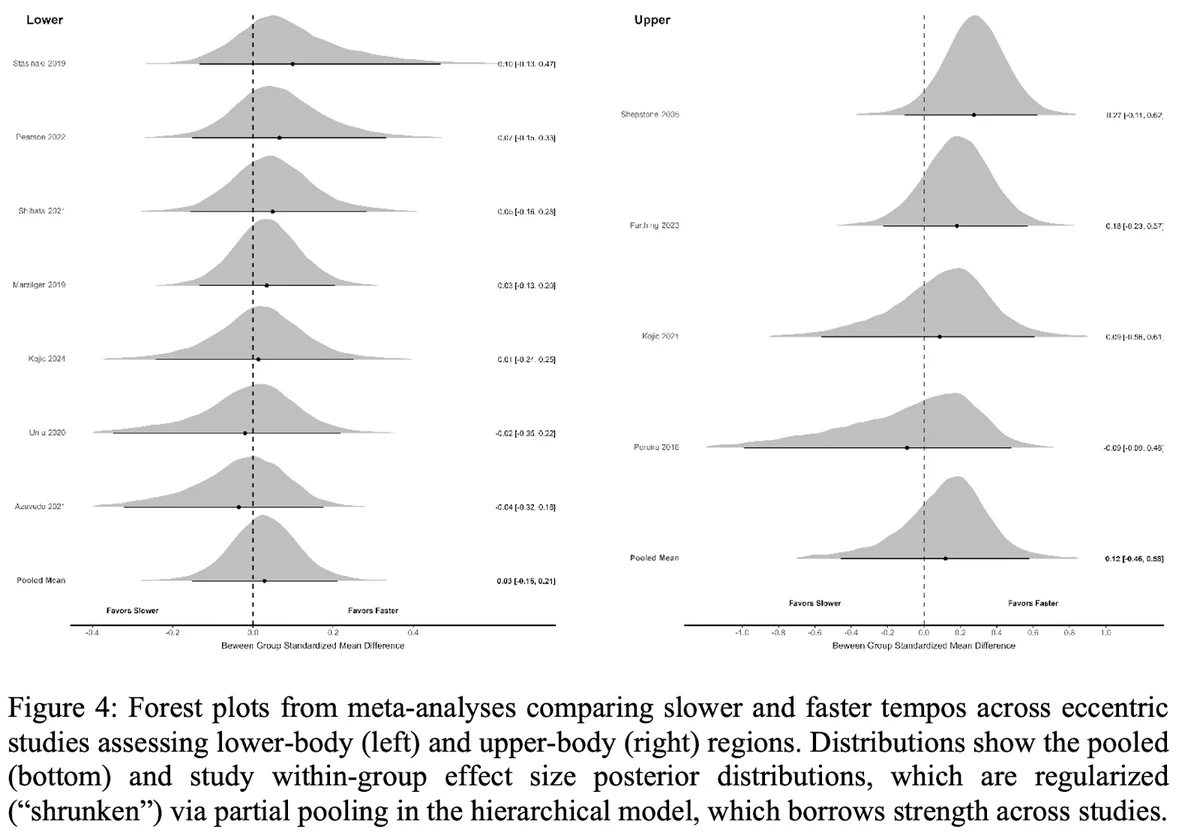
Here is what it found: both fast and slow tempos produced similar hypertrophy across the board. The results held for both upper-body and lower-body training.
There was a nuance, though. When people were not training close to failure, faster eccentric tempos had a slight edge. When they pushed to failure, slower eccentrics pulled slightly ahead — but the differences were small and uncertain.
The How
So where does this leave us? Pretty much exactly where we started — just without the FOMO of optimization.
As long as you’re training close to failure, pick a tempo that feels right. If slowing down the lowering phase feels better on some exercises and speeding it up on others, follow what works for your body.
Exercise-Specific Tempo Tips
- Romanian deadlifts: control the eccentric — 2 to 3 seconds down helps you feel the stretch
- Barbell bench press: explode on the concentric, lower under control in about 2 seconds
- Pull-ups: try a slightly slower lowering phase if you’re not quite reaching failure on your sets
How to Count Your Tempo
If tempo notation is new to you, here’s the simplest way: count out loud as you move. A 2-0-2 tempo means 2 seconds lowering, no pause at the bottom, and 2 seconds pressing up. Start with that and adjust from there.
The Takeaway
Tempo is a tool, not a rule. My notebook says this clearly: the biggest driver of growth is how close you train to failure, not exactly how many seconds each rep takes. Lift in a way that suits your preference and your exercise.
Your Move:
- Step 1 — Pick one exercise today and count your reps out loud for the next set. Just feel it.
- Step 2 — Notice whether slowing the eccentric or speeding up the concentric feels better on that movement.
- Step 3 — Stick with whatever tempo lets you train closest to failure. That’s where the growth lives.