
The first time I stepped on my body composition scale after months of steady training, I noticed something confusing: the weight hadn’t moved, but my clothes fit better. My legs looked fuller. The number on the screen lied.
That’s body recomposition — gaining muscle while losing fat at the same time. It sounds almost too good to be true. And among experienced lifters, it often is dismissed as something only beginners or steroid users get to enjoy. Once you’ve been training for a few years, the argument goes, you must pick a lane: cut or bulk.
But when you dig into the research, the story isn’t quite that simple.
The Science
Several studies have compared being in a calorie surplus versus eating at maintenance while resistance training. Generally, a surplus produces similar or slightly greater gains in muscle size. The rationale is intuitive: extra energy could facilitate recovery, speed glycogen replenishment, and let you train harder — all of which support hypertrophy.
That said, the difference between a mild surplus and maintenance is smaller than many assume. Most studies found improvements in indirect measurements of hypertrophy (lean body mass), which may be more easily swayed by simply being in a surplus versus truly seeing more muscle growth.
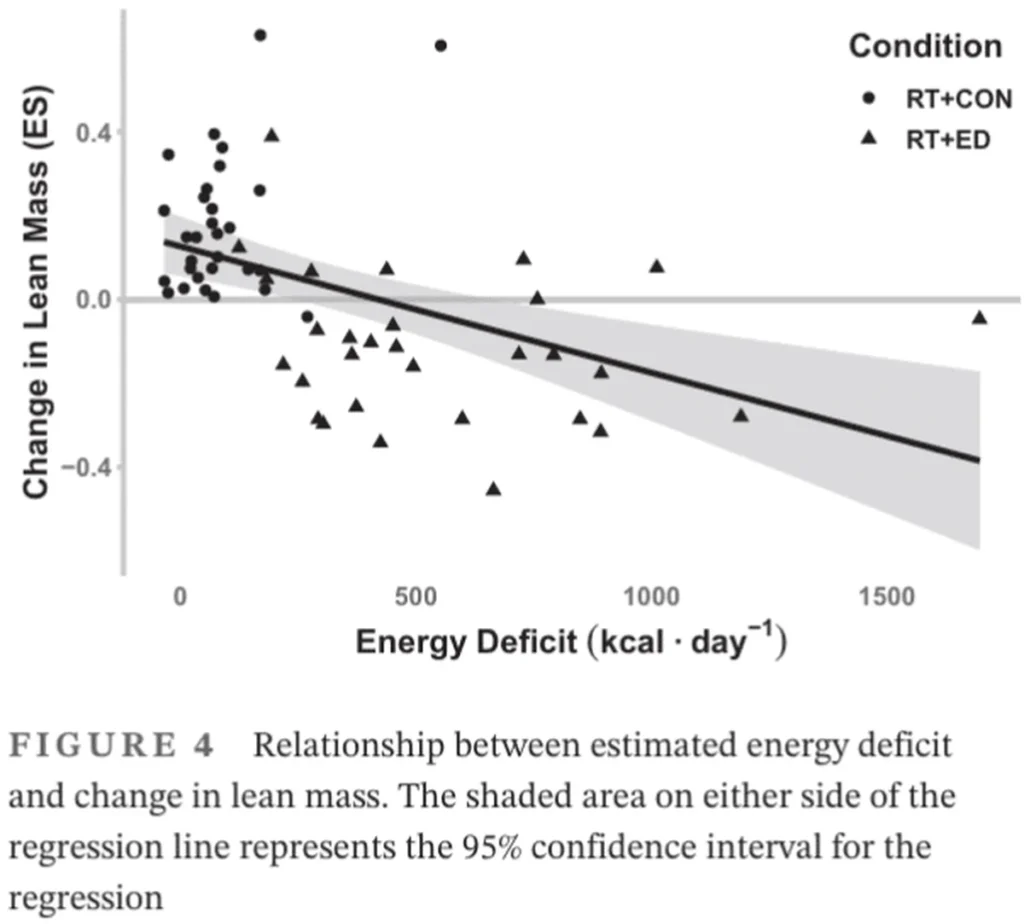
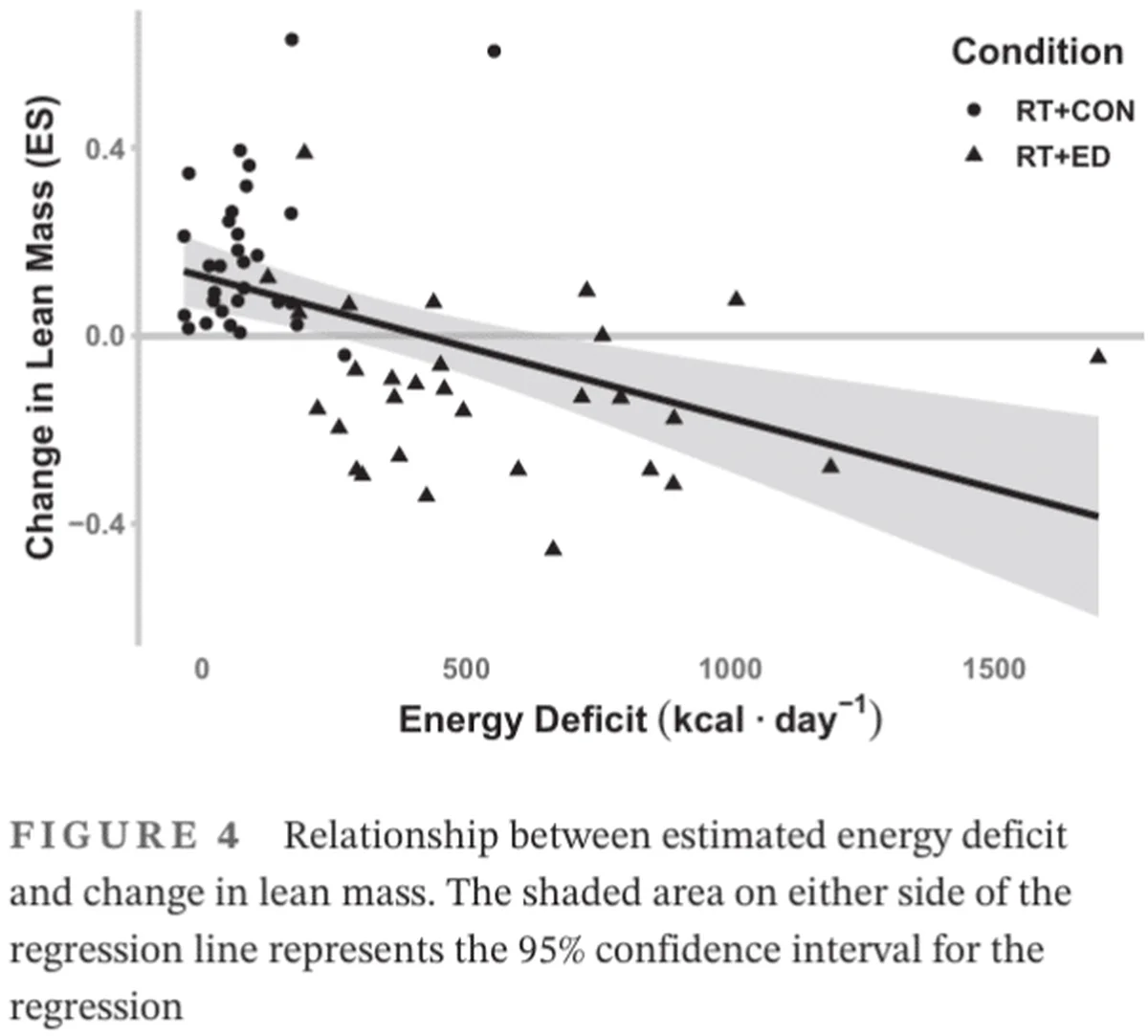
In a meta-regression of 52 training studies, Murphy and colleagues found that being in a deficit clearly reduced muscle gain — but most participants training around maintenance still increased lean mass. Across hundreds of resistance-training studies, bodyweight typically stays stable while participants report increased muscle size and reduced fat mass simultaneously.
The Energy Cost Myth
One common misconception is that building muscle consumes a ton of energy — therefore, a calorie surplus is required to fuel it. However, that’s simply not true.
A review by Slater et al. put the metabolic cost of building skeletal muscle mass at around 12.7 to 19.5 kJ per gram (about 3–4.6 kcal per gram).
Coach’s Math:The average intermediate lifter might gain around 2–4 lb (0.9–1.8 kg) of muscle in a year. The energetic cost of depositing that tissue would be roughly 3,450 to 9,800 kilocalories per year. On a daily scale? That’s just an extra 9 to 27 kcal per day.
There are three reasons this is noteworthy:
First, that’s an incredibly small number of calories.
Second, hitting a surplus that exact in size is practically impossible. Food labels vary by several percent even under controlled conditions, and estimating intake from mixed meals introduces far larger errors.
Third, that tiny energetic requirement can almost certainly be met endogenously — your body draws stored energy from glycogen or fat to cover it.
In short, synthesizing new muscle tissue doesn’t require a measurable surplus on any given day.
Where You Fit on the Continuum
Rather than seeing ‘cut,’ ‘recomp,’ and ‘bulk’ as rigid modes, view them as points on a continuum of energy balance:
- Deficit: maximizes fat loss but tends to limit or slightly reverse hypertrophy.
- Maintenance: allows moderate fat loss and moderate muscle gain simultaneously.
- Surplus: maximizes hypertrophy, at the cost of some fat gain.
Where you fall depends on your training quality, recovery, and current body composition. Someone with higher body fat has more stored energy to draw from, making recomposition easier. Someone already very lean may need a true surplus to build efficiently.
The Caveats
My notebook says two things are worth keeping in mind.
Training status matters for pace, not possibility. Most studies involve relatively untrained or intermediate lifters. As you get more advanced, the total rate of muscle gain slows dramatically. Recomposition becomes slower — but not impossible. Both bulking and recomping yield smaller returns at higher levels. The difference is pacing, not feasibility.
Body fat level sets your boundaries. At extremely low body fat, maintenance calories might limit growth. If you’re well below your natural settling point, recomp will be harder to achieve. But if you’re near or above it, recomposition is surprisingly achievable.
The Takeaway
Body recomposition isn’t a myth. It’s a regular outcome in research and in practice. The magnitude of change might be modest, especially for advanced lifters, but it happens nonetheless.
A dedicated bulk still makes sense if you’re relatively lean and comfortable adding some fat for faster gains. But if you’re near your long-term target weight or prefer a steadier approach, staying around maintenance and focusing on progressive training may give you the best balance between strength, muscle gain, and aesthetics.
Your Move:
- Check today’s scale number against how your clothes fit — they don’t always tell the same story.
- Aim for maintenance calories this week while keeping your protein intake consistent.
- Track one strength metric (a lift, a rep PR) alongside body weight so you can see recomposition in action.