

The crown did something it wasn’t doing two years ago. I caught it in a lift mirror, under fluorescent light, and the old binary kicked in: do nothing, or book a hair transplant. Neither felt right. So I went down the middle road instead — the one the industry keeps calling “stem cell and exosome,” which is really just marketing for a procedure called autologous micrografting, or AMT.
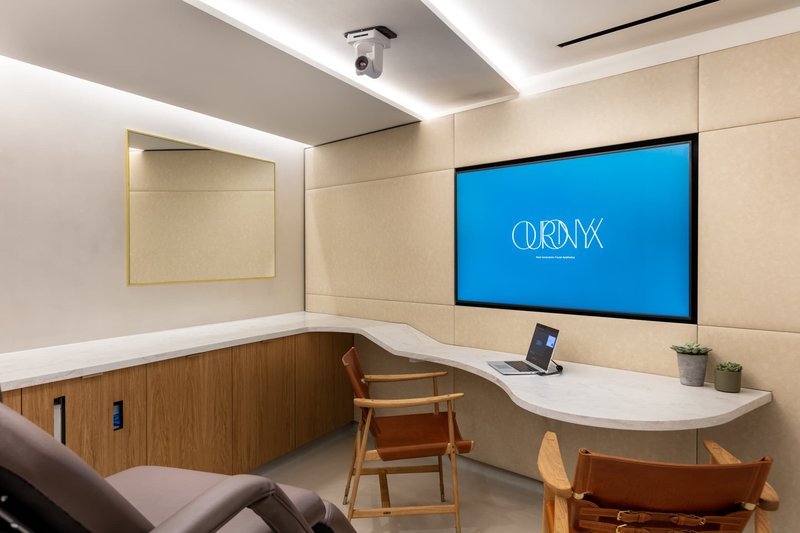
I had it at Ouronyx on St James’s Street in April 2026. Four months later I have two scan sets to show for it. Here’s what it is, what happened, and what I can honestly claim about the results.

The Why: what it actually is
Strip the marketing away and AMT is a tissue transfer — not a drug, not a transplant. A doctor takes two or three tiny punches of skin, around 2.5mm, from the mastoid area behind the ear or the nape. That spot matters: that hair is genetically resistant to the hormone behind male pattern baldness.
The tissue goes into a device that mechanically breaks it down and filters it into a liquid suspension — progenitor cells, growth factors, and exosomes, all of it yours. Then it gets injected across the thinning areas in a grid of small mesotherapy-style points. One appointment. Nothing cultured, nothing frozen, nothing arriving in a vial from elsewhere.
The mechanism, as far as the literature understands it, isn’t that new hair is created. It’s signalling. The suspension delivers cytokines and growth factors that slow follicle cell death, calm inflammation, and encourage new blood supply — while the exosomes appear to carry messages between hair follicle stem cells and the dermal papilla cells that run the growth cycle. In plain terms: you’re not adding hair. You’re talking struggling follicles out of retiring.
Dr. Marco Nicoloso, Medical Director at Ouronyx in London, puts it this way:
“Micrografting Technology is the ability of micrografts to stimulate the dormant hair follicular units, reverting the shrinking process typical in Androgenetic Alopecia and thereby inducing the development of new hair follicles.”
Ouronyx’s own launch release adds the more honest line, and I’d go in expecting that one: “It is important to understand that Micrografting won’t create new hair on your scalp. But it will encourage existing follicles to grow, so sparse areas on the scalp will become thicker and fuller.” Reversing miniaturisation is well supported. Generating genuinely new follicles is a bigger claim than the trial data currently carries.
The distinction that matters most before you spend any money: a transplant moves hair. AMT tries to save the hair you still have. If you’re already bald on top, this isn’t your treatment.
The How: what the appointment was like

The consultation comes first. At Ouronyx that means a 3D trichoscopy scan — high-magnification imaging that measures follicle density, hair calibre, and scalp inflammation, mapped so it can be repeated later against the same coordinates. That’s the most useful part of the whole process, because it converts “I think it’s getting worse” into a number.
The treatment took around an hour. Local anaesthetic behind the ear, the punches taken — pressure rather than pain — then the processing while you sit there, then the injections across the scalp. The injections are the least pleasant bit, and still, on a scale of things people willingly pay for, nothing.
Now the honest part, because brochures all say some version of “no visible marks, return to daily life immediately.” I had a plaster behind my ear for two days, and two slightly odd red dots at the donor sites that lingered a couple of weeks until my hair grew back over them. No scarring, no bandage, no hat, nothing anyone commented on. But “no visible marks” is a stretch if you run a very short back and sides and land in a wedding photo the following weekend. Book accordingly. Beyond that: I went back to normal that afternoon.
The numbers, four months on
Two scans, same clinic, same machine: a baseline on 09/04/26 and a follow-up on 06/08/26. The TrichoLAB system measures four zones — the three treated areas, plus the androgen-resistant occipital area at the back of the head, which acts as the untreated reference.
- Crown: 147 to 203 hairs/cm² — up 38%. Cumulative thickness rose from 6.0 to 7.8 mm/cm².
- Frontal: 121 to 175 hairs/cm² — up 45%. Shaft thickness up from 47 to 52 microns.
- Right temple: 128 to 219 hairs/cm² — up 71%. Shaft thickness up from 41 to 50 microns.
- Terminal-to-vellus ratio improved everywhere: 57% to 60% at the crown, 66% to 74% at the front, 58% to 81% at the temple.
- Derived Sinclair scores moved with it: 3.3 to 2.8 at the crown, 3.5 to 2.3 at the temple.
I saw it in the mirror before any of this was on a screen, at around the three-month mark. But one confound, and I’ll flag it before you do: I also started minoxidil this year, after the treatment. Minoxidil is broadly accepted to take three to six months before it does anything visible, so on timing alone the early improvement lands in AMT’s column. Four months out, though, I can’t tell you the two are cleanly separable. Anyone who claims otherwise about their own head is guessing.
Not medical advice — if you’re deciding between treatments, take these numbers to a doctor who can read your own scans, not a review.
AMT vs the alternatives
Four things get sold to people with thinning hair, and they do genuinely different jobs.
- AMT — signals the follicles you still have, using your own tissue taken, processed, and reinjected in a single sitting. Best for early to moderate thinning where the goal is preserving what’s there. One appointment, effectively no downtime, repeated somewhere between annually and every three years depending on the protocol.
- Hair transplant (FUE) — the only one of the four that physically relocates follicles, and therefore the only one that can fill an area where nothing is growing anymore. One surgery, six to twelve months to the final result, recovery measured in days to weeks.
- PRP — spins the platelets out of your own blood and injects them to signal the follicles. Same broad idea as AMT, but a different payload and no cells in it. Three to six sessions up front, then top-ups, minimal downtime.
- Off-the-shelf exosome shots — donor-derived vesicles bought in a vial, usually sold as a course of several. The one to think hardest about.
PRP is the comparison most people will actually be weighing, since it’s cheaper and far more widely available. But micrografts, unlike PRP, contain progenitor cells, “which are key for stimulating hair growth.” PRP delivers growth factors from your own blood; micrografts deliver growth factors plus the cells themselves. Whether that justifies the price gap is a judgement call — but it isn’t marketing. It’s a real difference in what’s going into the syringe.
The exosome question nobody wants to discuss
“Exosome therapy” has become a catch-all in aesthetics, and it covers two very different things. The MHRA regards injected exosomes as medicinal products, and no injectable exosome product currently holds a UK marketing authorisation for aesthetic use; human-derived exosomes aren’t approved for cosmetic use in the UK or EU. If you’re in the US or elsewhere, check what the FDA or EMA says about the specific product in the vial before you let anyone inject it. And if a clinic is offering you exosomes from a bottle — donor-derived, cultured, bought in — you’re entitled to ask what’s in it and under what authority it’s being injected.
AMT is a different proposition. The exosomes involved are the ones already in your own tissue, isolated mechanically and returned to your own scalp in the same appointment. No cultured product, no donor, no vial. That’s the reason I was comfortable with this treatment and wouldn’t be with the other kind. If you take one thing from this piece, take the question: whose cells are these, and when did they leave my body?
How often do you actually need it?
This is where the honest answer and the commercial answer diverge slightly, and it’s worth knowing before you commit. Ouronyx’s protocol is one session every twelve to eighteen months in most cases, each around an hour. Other UK clinics running the same family of technology frame it completely differently: a single treatment, repeated only after two to three years, and only if your loss has visibly progressed. That’s an enormous spread for essentially the same procedure, and nobody in the industry seems especially keen to reconcile it.
The trial data leans toward the less frequent end. In the published work on the Rigenera system, patients who had a second session six months after the first showed no additional benefit over those who had one. That doesn’t mean top-ups never help — hair loss is progressive, and a treatment that slows it will eventually need repeating. But the case for two sessions inside the first twelve months is considerably weaker than the case for one session and a rescan.
My plan is one treatment, measured at six and twelve months, with the repeat decision made on the numbers rather than the calendar. That’s the real argument for a clinic that scans you properly: you buy the second session because the density has slipped, not because a year has elapsed.
What it costs
Ouronyx prices micrografting at £2,950 a treatment. Against a UK transplant — starting around £3,000 and routinely running past £10,000, with a visible recovery — it’s a different order of spend for a different job. Against £15 a month of minoxidil, it’s obviously a lot of money. AMT is a preservation strategy for people who still have something worth preserving, not a rescue.
Would I do it again?
Yes — with two conditions.
Only alongside the scan. The trichoscopy is what turns this from an expensive act of faith into something you can audit. I’d be reluctant to have AMT anywhere that couldn’t measure me before and after against the same map. One refinement I’d add: ask for the control area’s numbers alongside your own, every time. It costs nothing, and it’s the only thing standing between you and a very flattering percentage.
Only as part of the stack, not instead of it. The evidence base is real but modest — small studies, follow-up typically capped at six months, improvement reported in roughly two-thirds of patients, with quantitative density gains described as small relative to normal measurement fluctuation. One study found a second session six months later added nothing over the first. That’s a promising complementary treatment, not a cure — and the clinics doing this properly say as much.
What it genuinely is: the option that didn’t exist a decade ago. Something between doing nothing and having surgery. For the people catching themselves in the lift mirror rather than the ones already past it, that’s the only gap that matters.
FAQs
Is AMT a hair transplant?
No. A transplant relocates follicles from the back of your head to the front. AMT takes a few millimetres of tissue and uses the cells within it to stimulate the follicles you already have. Nothing is moved and nothing is added.
How long until you see results?
Reduced shedding is typically reported at six to eight weeks, visible density changes over three to six months, full results at around six. Mine were visible at around three months.
Is there downtime?
Effectively none. A plaster behind the ear for two days and, in my case, two small red dots at the donor sites that faded over a couple of weeks. No time off, no hat.
Can you combine AMT with minoxidil or finasteride?
Yes, and most protocols assume you will. AMT is positioned as complementary to medical therapy rather than a replacement for it — which is also, inconveniently, why it’s hard to attribute results cleanly.
Does it work for women?
Yes. Autologous micrografting protocols are used for both men and women, and the published studies include female patients.
How often do you need AMT repeated?
Ouronyx’s protocol is one session every twelve to eighteen months in most cases. Other UK clinics treat it as a one-off, repeated only after two to three years if loss progresses. The published trial evidence found no added benefit from a second session at six months. The honest answer: have one, get rescanned, and let the density numbers decide.
Disclosure: this treatment was provided for review. The words, the scan results, and the opinions are entirely my own.
Your Move:
Step 1 (5 minutes): book a trichoscopy scan at a clinic that measures density and calibre — you can’t audit a treatment you can’t measure.
Step 2: ask two questions before any injection: whose cells are these, and under what regulatory authority?
Step 3: if you proceed, rescan at six months and let the numbers — not the calendar — decide on a second session.